
Weslaco City Directory Collections
The accessible Texas State Library and Archives Commission city-directory inventory confirms one local entry: Weslaco, 1974. The inventory row does not identify a publisher, and it does not establish a longer Weslaco run. That limit matters. Treat 1974 as a verified volume to inspect, not as proof that adjacent years were printed, survived, or are held locally. Older Hidalgo County land, tax, marriage, and probate material can still supply dates and family connections when a city directory is absent.
| Collection | Verified years | Where held | Access route |
|---|---|---|---|
| Weslaco city directory | 1974 | TSLAC inventory; confirm a physical holder through a local or academic library | Request page images, interlibrary loan, or a local catalog check |
| Texas city and telephone directories | Weslaco-specific range not verified | TSLAC print or microform, Library of Congress, and library collections | Search by place and time; nearby communities may appear in a regional volume |
| Hidalgo deed indexes and books | 1852–1888; supplements through 1912; Spanish-transcribed deeds 1854–1896 | TSLAC/UTRGV microfilm and the County Clerk | Use direct and reverse party indexes with a legal description |
| Hidalgo tax rolls | 1852–1910 | TSLAC/UTRGV microfilm | Use a taxpayer or parcel clue to bridge a directory gap |
The TSLAC inventory image shows the verified Weslaco listing that anchors this historical city-directory search.
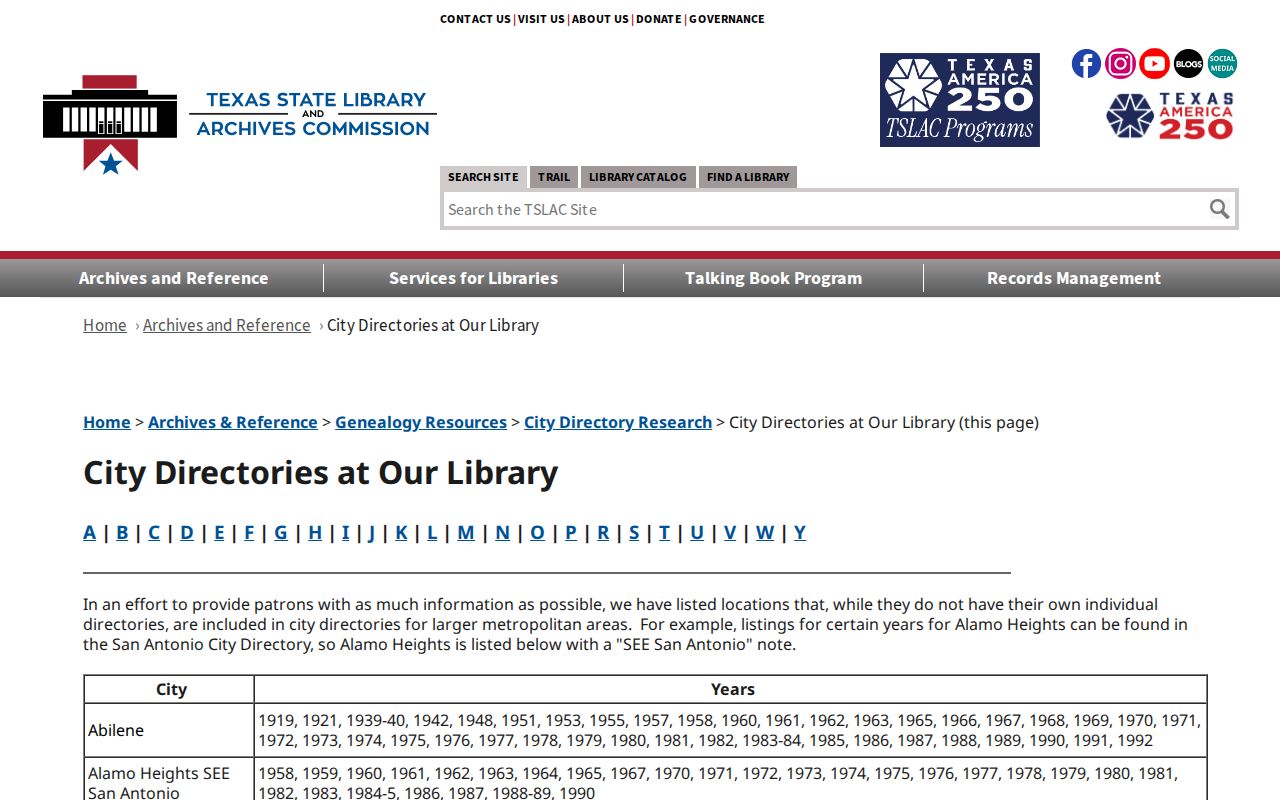
Use that listing as a starting point, then confirm the volume, condition, and access method with the repository before making a trip or ordering a copy.
Weslaco City Directory 1974
A single dated listing is more useful than an assumed shelf. The Weslaco city directory identified by TSLAC can help place a surname, street address, telephone number, occupation, employer, or spouse notation in that year if those fields appear on the actual page. It cannot, by itself, prove a person occupied the address before or after the volume's publication. Directories were often compiled by canvass and published irregularly, so absence can mean an unlisted household, a regional listing, or a missing volume rather than an empty address.
For a first request, supply the surname, the likely street, and the target year. Ask whether there is an alphabetical section, a street or address section, and an abbreviation key. Keep a citation to the page or section. That makes it possible to revisit the evidence if a later deed, census schedule, or obituary points to a different household.
Note: A missing Weslaco directory year is an evidence gap, not proof that no household lived at an address.
Weslaco City Directory Access Paths
TSLAC's city-directory research guidance points researchers to print and microform holdings and describes routes through the Portal to Texas History and library-provided HeritageQuest access where available. When a local shelf lacks the verified volume, ask Sanchez Public Library for interlibrary loan or a referral to TSLAC or UTRGV. The detailed current Sanchez shelf, reverse-directory run, newspaper microfilm run, and licensed-database list were not located in the research, so none should be assumed.
The TSLAC city-directory guide illustrates the state library's routing advice for print, microform, and digitized-material searches.
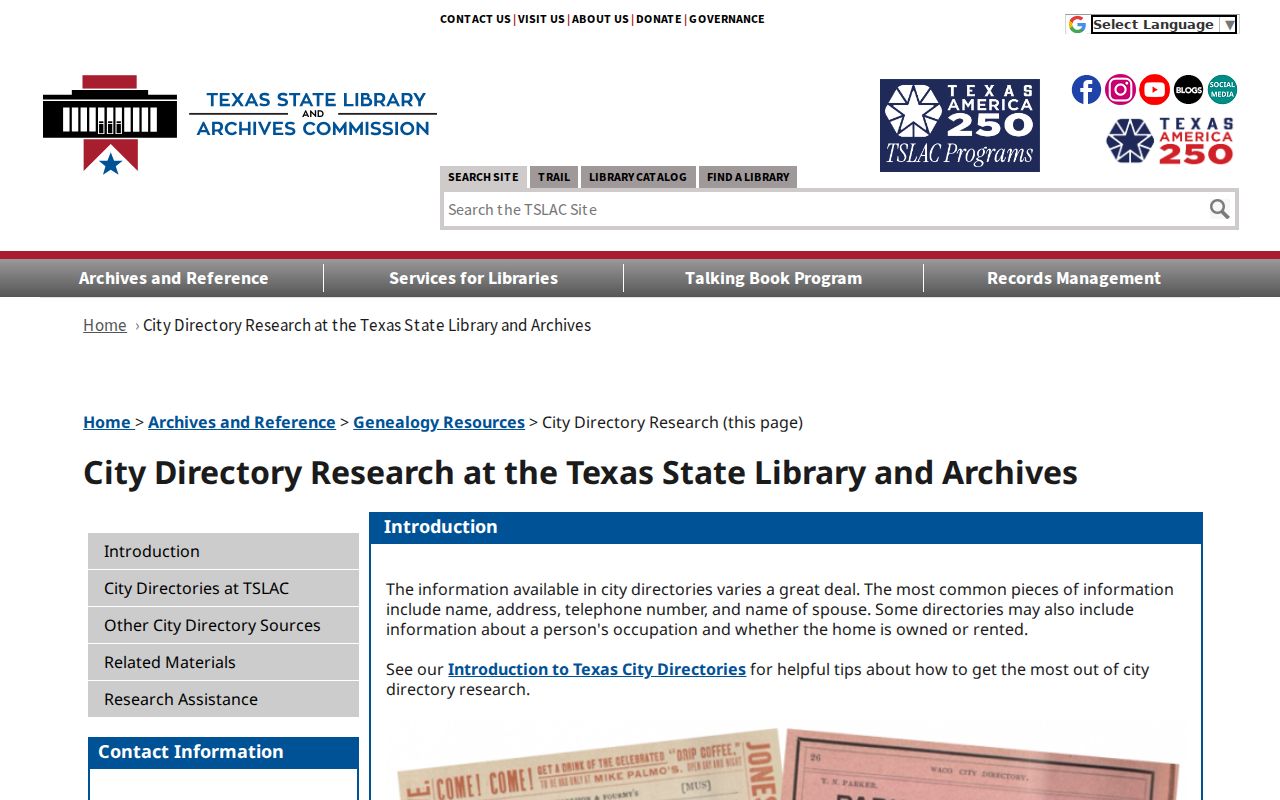
It supports a practical sequence: check the verified inventory, ask a library about access, then expand to statewide or regional directories without claiming that an unverified volume is a Weslaco volume.
UTRGV in Edinburg is identified by the TSLAC microfilm guide as a holder for listed Hidalgo County reels. Call ahead about reader access, reel retrieval, copying rules, and possible FamilySearch substitutes.
Weslaco City Directories Online
The Portal to Texas History directory search is a useful digitized-material route because its results can be narrowed by county or time when the collection supports those filters. A search result may be for a larger nearby city, a telephone directory, or a different Texas community. Read the item title, date, and place information before treating it as Weslaco evidence. The Library of Congress also documents city, telephone, reverse-telephone, and criss-cross directory holdings, but its national inventory warns of gaps.
The Portal to Texas History search screen is the verified digital entry point for exploring Texas directory material.
It is a discovery tool, not confirmation of a complete Weslaco run. Save the item record with every page image so that the locality and date remain attached to the transcription.
Reading a Weslaco City Directory Entry
No verified Weslaco page image was available during research, so the fields below are an inspection checklist, not a reconstructed local entry. Transcribe what the volume actually prints. A name can appear with an initial, a spouse in parentheses, an address, an occupation, an employer, a telephone number, or a business listing. An address section, when present, may put the street first and point back to an alphabetical page.
| Name form | Record surname, given name or initial, and every spelling exactly as printed. |
|---|---|
| Household clues | Note a spouse, widow or widower wording only when the page itself supplies it. |
| Address | Copy the number, street, directional prefix, unit or room, and any page reference. |
| Work or telephone line | Transcribe an occupation, employer, telephone, or business listing if the volume includes it. |
| Ownership notation | Copy an owner, renter, or similar mark only after checking the directory's own key. |
- Criss-cross directory
- An address-ordered directory that can lead from a street number to a listed household. A Weslaco-specific run was not verified.
- Householder index
- An index organized around the person or household named at an address, rather than a complete list of everyone there.
- Abbreviation key
- The volume's explanation of its symbols and shortened words. Photograph or copy it before interpreting a notation.
Weslaco City Directories and Census
Pair city-directory clues with federal census schedules rather than joining two people only because their surnames match. The released federal census span reaches 1950 under the 72-year rule, while 1960 is the next normally scheduled release. A census can add household relationships, ages, birthplaces, and neighborhood geography. A directory can supply the in-between address, occupation, or spouse notation. Neither record is a substitute for a deed when the question concerns title.
- Find the known surname and address in the available directory volume, then capture the entire entry and its page reference.
- Check the address section when it exists, preserving the street-number form and the abbreviation key.
- Compare the next available directory or related telephone volume, but mark every missing year as a gap.
- Match the household to a released census using several details, such as spouse, age range, children, street, or place.
- Test a move or ownership claim against tax, deed, probate, or obituary evidence from the proper custodian.
South Texas names deserve extra care. Search compound surnames, paternal and maternal order, initials, Spanish and English given-name variants, and accented or unaccented forms. Never merge a household on surname alone.
Weslaco Museum Archive Requests
Weslaco Museum accepts formal archive-research requests for its cataloged artifacts and papers. Its records room is a local lead for family names, businesses, photographs, institutions, and community history, rather than a searchable household database. Send a focused request with an address or name, a date range, and a clear question. The museum's request page says to mail the form to 500 S. Texas Blvd., Weslaco, TX 78596, or send it as an attachment by email to a staff member; no fee or turnaround time is stated.
The museum was built from local community collecting, and its exhibits address immigration, agriculture, education, military history, and twentieth-century life. That makes it especially helpful when a directory name needs context that a government index cannot provide.
The library and museum have a documented history of shared local context. The Sanchez Public Library began in 1948 through volunteer work and later moved into a city-funded 1966 facility that is now the museum. That history helps explain why a directory, newspaper clipping, or community paper may be associated with more than one Weslaco institution. The current official library shelf, obituary-index, telephone-book, and microfilm runs were not located in the research. Ask the library for a catalog check, interlibrary-loan help, and its current genealogy resources rather than assuming a collection is on site.
Note: A library referral or museum archive lead identifies where to ask, not proof that a particular Weslaco directory volume is held there.
Weslaco Directory Gaps Compared
Current online indexes and archival reels answer different questions. The Hidalgo County Clerk official-records portal is a present-day entry point for recorded instruments, but it does not state a complete historical start date. TSLAC's Hidalgo guide documents direct and reverse deed indexes and deed books beginning in 1852. An online name result can therefore be quick, while a microfilm search may be the stronger route for a nineteenth-century parcel or family connection.
Directory evidence has a similar split. A digitized search can surface an item fast, while the bound volume or microform gives the page, key, and neighboring entries needed for a careful reading. If an expected year is missing, combine deeds, tax rolls, censuses, permits, probate, newspapers, and obituaries. Do not fill the interval with a guess.
Weslaco City Directory Timeline
Directory research sits within a longer Hidalgo County records history. The dated points below identify what is verified, while leaving unverified publisher changes and local shelf runs open for future repository checks.
- 1852: Hidalgo County formed, establishing the county-level setting for early deeds, tax rolls, and court material.
- 1919: Weslaco incorporated, a useful dividing line between early county land evidence and later municipal growth.
- 1974: TSLAC's city-directory inventory records a Weslaco entry; its publisher is not identified in that row.
- 1991 revised: The Texas Archives catalog describes a Weslaco water and street map, originally published in 1969, as context for streets and infrastructure.
- 2025: Hidalgo County's courthouse transition changed the physical research setting while clerk and archive systems continued to hold historical records.
Note: No verified local source establishes a complete directory timeline, a publisher sequence, or a single date when all Hidalgo records became digital.